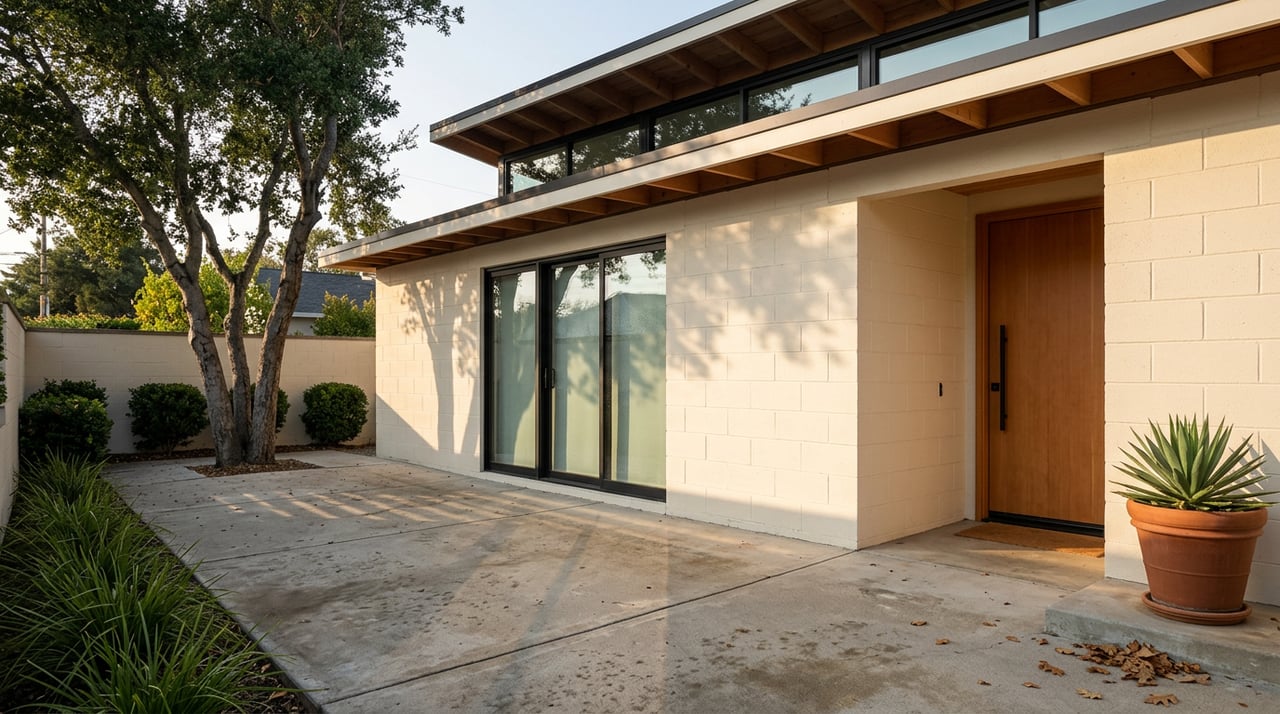
The Last Complete Gregory Ain Neighborhood Is Rewriting Its Own Rulebook This Year
September 3, 2026
September 3, 2026
Landon Moreland moved to the Mar Vista Tract a few years after the city designated it a historic district, and like a lot of new owners, he assumed the rules were simple. "Some people thought it was just a facade thing," he told the Eichler Network. If you leave the front of the house alone, you're fine. Then he found out it wasn't that simple at all, and the rules governing what he could and couldn't do to his own property were, in his words, still being worked out.
That was true when he said it, and it is arguably more true right now than at any point since the district was created in 2003. The fifty-two houses on Meier, Moore, and Beethoven Streets sit inside one of thirty-five Historic Preservation Overlay Zones in the City of Los Angeles, and this year the city is in the middle of rewriting the objective standards that govern new construction and accessory dwelling units inside every one of those districts, this one included. If you own, are buying, or are selling a home here, the rulebook you think you understand is not finished being written.
Gregory Ain designed the tract in 1948 with architects Joseph Johnson and Alfred Day, and landscape architect Garrett Eckbo laid out the streets so the houses would read as a single composition rather than fifty-two separate lots. Only fifty-two of a planned one hundred homes were ever built, because the Federal Housing Administration balked at financing anything so aggressively modern. In 2003, the tract became the first postwar Modern-style historic district in Los Angeles, which is a bureaucratic way of saying the city agreed these houses were worth protecting from the kind of remodeling that has erased most other postwar tracts in the region.
That protection used to be a nice architectural footnote. It stopped being just that in January 2025. The Eaton Fire destroyed twenty-one of the twenty-eight houses in Ain's other tract, the Park Planned Homes development in Altadena, according to reporting on the property in December 2025. That leaves the Mar Vista Tract as the only complete Ain neighborhood still standing. The HPOZ designation that Landon Moreland found confusing is now the only thing standing between fifty-two intact houses and the same slow erosion that has already claimed most of Ain's other work.
According to the Mar Vista Preservation Plan, the HPOZ Board is five residents with backgrounds in preservation, architecture, real estate, or construction, and it functions as an advisory body to the city's Department of City Planning rather than a final decision maker on every project. What actually happens to your application depends on what you're asking to do.
| Type of project | What it typically requires |
|---|---|
| Routine maintenance or in-kind repair | Requirements depend on the work proposed |
| New construction on a vacant lot, or replacing a demolished non-contributing structure | A Certificate of Compatibility, a formal application, and a public hearing before the Board |
According to the Los Angeles Department of City Planning, anything that reaches the Board hearing stage triggers a notice requirement: owners within a certain proximity, including anyone across the street or sharing a common corner, must receive written notice at least ten days before the meeting, and the applicant has to post the site itself for the same ten days. Because the Board is a public body under the Brown Act, meetings are open, agendas post seventy-two hours in advance, and public comment is capped at two minutes per speaker. None of this is designed to be punitive. It exists so that a change to one house doesn't quietly reshape what the whole street looks like, which is precisely the outcome the tract's preservation plan is trying to prevent.
A Mills Act contract is one detail worth asking about when evaluating a property in the tract. Sales on the Mar Vista Tract have ranged from roughly one point six million to just under two point five million dollars in the past few years.
For a seller, whether a Mills Act contract is part of the property's history can be a pricing conversation. For a buyer, it is a question worth asking as part of due diligence.
This is where the timing actually matters. In November 2025, the city's Office of Historic Resources contracted a preservation consulting firm to draft Objective Design Standards for new residential infill, mixed-use infill, and ADUs specifically within HPOZs, funded by a regional planning grant with a completion deadline at the end of 2026. The reason the city is doing this at all is that state housing law affects how certain streamlined housing applications are reviewed. Most HPOZ preservation plans, including this tract's, were written using exactly that kind of judgment-based language.
The draft standards went through a public workshop in April 2026 and a second one on June 30, 2026. The comment period, originally set to close July 21, was extended to July 28, 2026 after neighborhood associations across the city's HPOZs pushed back, arguing the draft language on things like ADU height limits was vague enough to undercut the very protections it was supposed to codify. Public hearings before the City Planning Commission and City Council are expected in late summer and early fall of this year. The Larchmont Buzz reports that the city has said explicitly that the underlying preservation plans for all thirty-five HPOZs will not be replaced by these standards. For a tract like this one, the process governing a new ADU or an infill project could look different by winter than it does today.
There is a second wrinkle worth knowing. A state law called AB 1061, effective January 1, 2026, sets specific standards for splitting a contributing lot inside an HPOZ, and as of this summer that language had not yet been folded into the city's draft. If you're evaluating a lot in the tract with any thought toward its long-term flexibility, that is a detail to track rather than assume.
None of this changes what has already been built. It changes the terms under which anything new gets approved from here forward, and it changes them while a house here is harder to find than it was even five years ago. Only a handful of the fifty-two Ain-designed homes have changed hands in recent years, and each sale draws attention specifically because it's rare, not because the tract is trending. A house that traded in 2014 reads, by current comparison, like a different market entirely.
If you're selling, the story worth telling a buyer isn't just "historic district." It's that this is the only complete example of this architect's tract housing left standing, and that the review process and its notice requirements are part of the story. If you're buying, the questions worth asking before you write an offer are whether a Mills Act contract exists, what condition the original character-defining features are in, and whether any planned changes, especially an ADU, might land differently under standards the city hasn't finished writing yet.
Does the HPOZ review apply to interior work? The safest step is confirming scope with the city before you assume anything is exempt.
What should a buyer check about a Mills Act contract? A buyer should verify details about any Mills Act contract with the city.
Will the 2026 rule changes affect houses that already exist, or only new construction? As written, the draft standards are aimed at new infill, mixed-use projects, and ADUs. The preservation plans governing existing contributing homes are not being replaced, though anyone planning new construction on a lot here should expect the goalposts to be clearer, and possibly different, once the standards are adopted.
If you're weighing a move in or out of the Gregory Ain Mar Vista Tract, or anywhere else on the Westside where a property's history changes the math, Lauren Morelli can walk through what a specific address actually allows, what it's worth, and what's still in motion at the city level before you make a decision. Reach out for a free home valuation and a straight answer on where things stand.
This article is general information, not legal, tax or financial advice. Consult a qualified professional about your situation.
Stay up to date on the latest real estate trends.

Get assistance in determining current property value, crafting a competitive offer, writing and negotiating a contract, and much more. Contact me today.